

A new truck driver can earn a steady paycheck within weeks of finishing school, but before that first check arrives, someone has to cover the cost of training. For students who are watching every dollar, that upfront price can make a CDL feel out of reach.
There are several ways to cover the cost of Class A CDL training:
- 529 education savings plans: Recent federal changes allow some 529 funds to be used for workforce training, including CDL programs.
- VA benefits: Some schools (like Elite) are VA-approved programs for service members, veterans, spouses, and dependents.
- Traditional financing: Some loan plans require little or no money down, and some do not start payments until after graduation.
- Workforce funding (WIOA): People who have been laid off or receive unemployment or SNAP benefits may qualify through Oregon WorkSource.
- Other sources: These include Vocational Rehabilitation, Trade Act programs, local banks, and service groups.
- Tuition reimbursement: Some trucking companies help pay back training costs after they hire a graduate.
Most of these options help before or during training. However, tuition reimbursement is different from the other options because it helps drivers pay for training after graduation, once the new driver is earning a paycheck. So how does it work, and who can get it?
Tuition Reimbursement Basics for New Drivers
Tuition reimbursement is a hiring perk with a delayed payout. The student covers training first, and the carrier that later hires them returns part or all of that cost. For carriers, it is a way to bring in drivers who already have solid training.
The payout is spread across many months. At Elite, carrier partners often send $100 to $250 a month toward a graduate’s CDL training loan, and many set the total limit at $7,000. These payments are typically added on top of regular wages, so nothing is usually subtracted from the driver’s take-home pay.
| Stage | Who covers the cost | What happens |
|---|---|---|
| Before training | The student, through a loan, savings, or another funding source | The student enrolls and sets up a payment plan |
| During training | The student’s plan stays in place | The student earns a CDL and meets carrier recruiters |
| After hiring | The carrier | Monthly payments go toward the training balance while the driver stays employed |
Carriers usually need paperwork showing the student’s training costs before their payments can start. Loan documents or a paid-in-full statement from the school are commonly used for this.
Here is an example of how tuition reimbursement typically works:
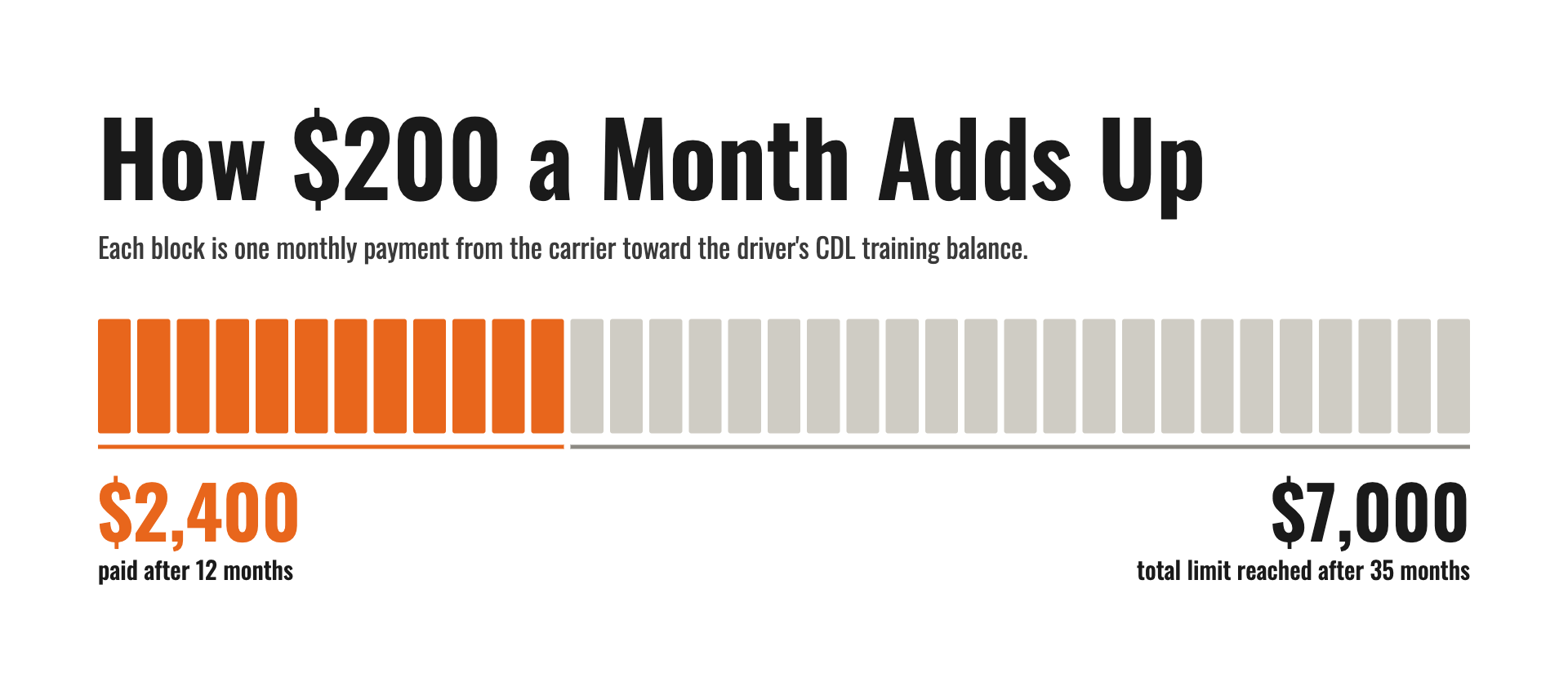
A student enrolls in and attends a CDL training program. They complete the program, graduate, and get their CDL. They then work with their job placement team and find a carrier offering tuition reimbursement for a driving role they’re interested in. They sign a contract with that carrier and start driving for them. The carrier then starts paying their reimbursement. A carrier that pays $200 a month would cover $2,400 in training costs by the end of the driver’s first year. At that rate, a $7,000 cap would be paid out in 35 months, or just under three years. If the driver owed $7,000, after three years of driving they would have no remaining balance on the cost of their CDL training program and would be able to switch carriers if they wanted to.
Who Can Get Tuition Reimbursement?
Almost any CDL school graduate and student can apply. Tuition reimbursement is not usually based on grades, income, or past work history. It is tied to getting hired, so any student who can meet a carrier’s normal hiring standards has a fair shot.
That includes:
- New drivers fresh out of CDL school with no trucking experience
- Career changers coming from retail, construction, warehouse work, or other fields
- Students who financed their training through a loan
- Students who paid for training with cash or a credit card
- Veterans and military family members, for any training costs they paid themselves
The main requirement is meeting the carrier’s hiring standards. Most carriers ask for a valid CDL, a passed DOT physical, a clean drug screen, and a driving record that meets their safety standards. Drivers who cross state lines must be at least 21 years old under federal rules.
One point is worth knowing up front. Reimbursement pays back costs the student actually owes or paid. If a grant or other program covered the full cost of training, there may be little or nothing left to reimburse.
Common Limits of Tuition Reimbursement
No two carrier programs share the exact same terms. Students who know the most common conditions can spot a solid offer and avoid surprises down the road.
| Condition | What it means for the driver |
|---|---|
| Hiring deadline | The graduate must join the carrier within a set period after school, from a few months up to about a year. |
| Ongoing employment | Payments continue only while the driver works there. A driver who leaves stops receiving payments and covers any remaining loan balance alone. |
| Monthly and total limits | The carrier pays a fixed amount per month up to a maximum. Any training cost above that maximum is the driver’s responsibility. |
| Cost records | The driver must show what training cost. Missing paperwork can delay or block payments. |
| School approval | Some carriers only accept training from an accredited or approved school. |
| First-time only | Some carriers decline if another company already paid back the same training. |
| Job type | OTR and regional jobs offer it most. Local routes offer it less often. |
Tuition reimbursement helps pay down a training loan, but the loan stays in the driver’s name until the balance reaches zero. How the payments are treated at tax time is another question worth raising with the carrier.
Students can bring any offer to Elite’s admissions or job placement team to review these conditions before accepting a job.
Carriers That Offer Tuition Reimbursement
Not every trucking company offers tuition reimbursement, and not every graduate will qualify for every program. Still, many carriers that hire new drivers use it to attract trained graduates. Two of Elite’s longtime hiring partners list it as a driver benefit.
Schneider National
Their paid CDL training page offers monthly payments of $200 for qualified drivers, up to $7,000 in total. Schneider has hired Elite graduates for nearly 20 years; Elite’s job placement team works closely with Schneider recruiters.
May Trucking Company
May Trucking is based in Salem, Oregon, and has also partnered with Elite’s job placement team to hire graduates for nearly 20 years. The company lists school tuition reimbursement on its driver benefits page, so it may be a good option for new drivers to consider.
Other Types of Carriers
Large OTR and regional carriers that hire entry-level drivers are the most likely to offer tuition reimbursement. Local delivery fleets and private company fleets offer it less often, though they may have other benefits, such as daily home time. Elite’s guide to the different types of truck driving jobs explains how these jobs compare.
Program terms change often, so the amounts above may not match a carrier’s current offer. Elite’s admissions and job placement teams keep track of which partners currently offer tuition reimbursement and what each one requires.
An OTR job with reimbursement can be a first step rather than a permanent choice. Elite offers job placement help for a graduate’s entire career, so drivers who later want a local or dedicated route have support.
Next Steps for Elite Students and Future Drivers
Paying for CDL school is rarely one single decision. Students can often combine sources, such as a training loan paired with carrier reimbursement, or WIOA funds paired with a 529 plan.
Tuition reimbursement fits into a student’s plan best when they learn about it early, before choosing a first job.
Current Elite students can ask an admissions advisor or the job placement team which carrier partners offer reimbursement right now and what each one requires. Future students can call 503-615-8465, visit the Admissions page, or reach Elite online to start putting a payment plan together.

Frequently Asked Questions
Does Elite Truck School pay tuition reimbursement?
No. Trucking companies fund tuition reimbursement, and Elite helps students connect with the carrier partners that offer it.
Can part-time students get tuition reimbursement?
In most cases, yes. Reimbursement depends on finishing training and getting hired, not on whether the student chose a full-time or part-time schedule.
Can a driver get a sign-on bonus and tuition reimbursement from the same carrier?
Often, yes. Many carriers that hire new drivers offer both benefits, so students should ask recruiters about each one.
Can Class B CDL graduates get tuition reimbursement?
Sometimes, but options are more limited. Most reimbursement programs come from carriers that hire Class A drivers for regional and OTR routes.
Can students at every Elite campus get tuition reimbursement offers?
Yes. All five campuses share the same network of hiring partners, though the recruiters on campus in a given week can vary.
