

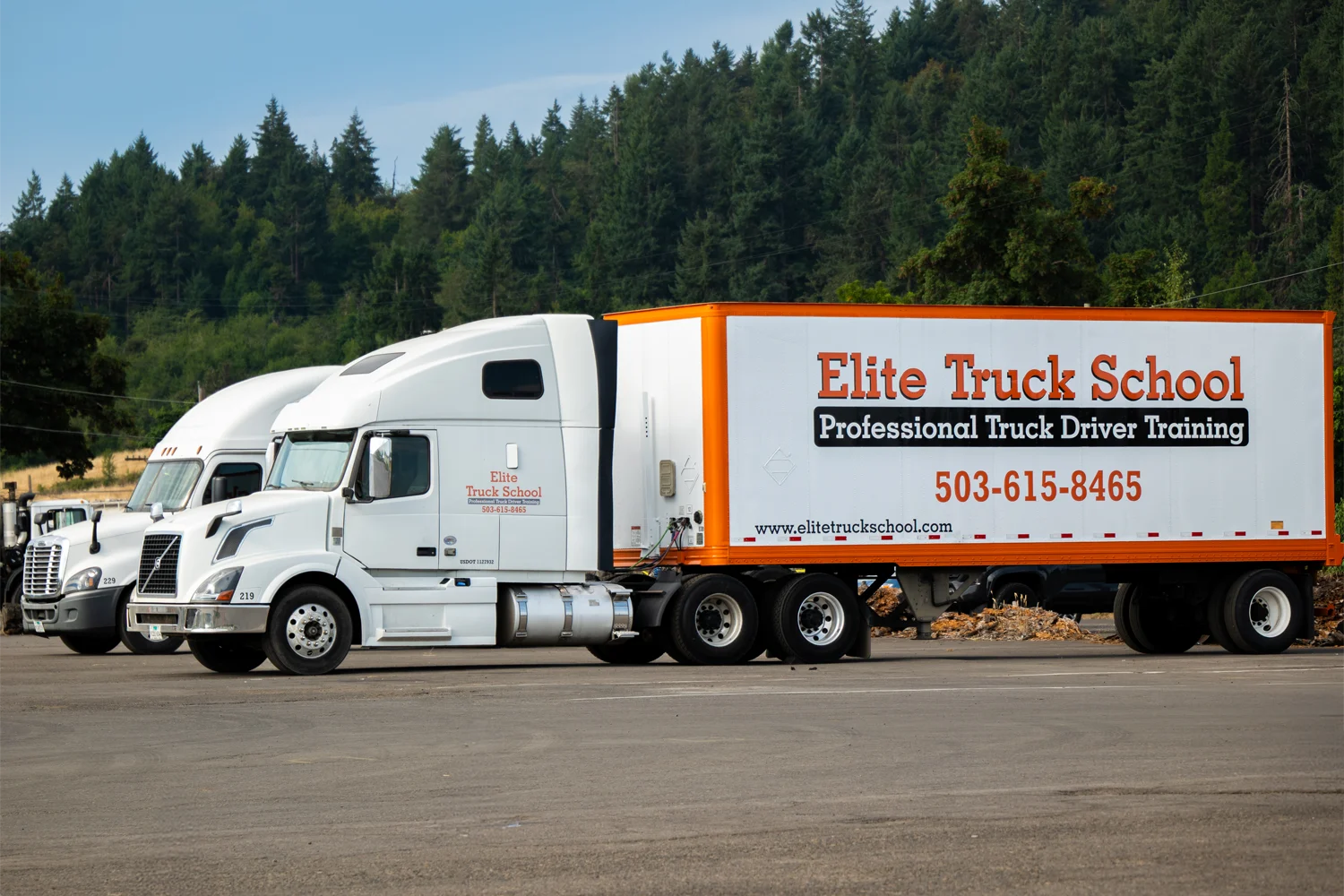
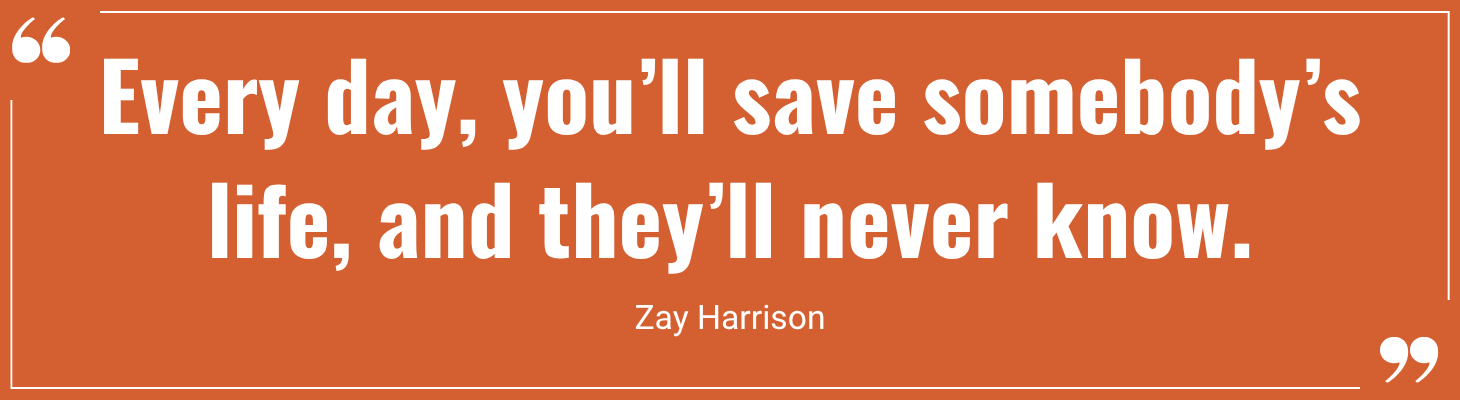
That is what Zay Harrison, Elite Truck School instructor, tells her students. Not as a motivational line, but as a truth she has lived firsthand. As a commercial truck driver, Zay has seen what it means to do the job, not just as someone who moves freight from point A to point B, but as someone who shows up for the road and the people on it.
Today, Zay brings that experience into the classroom at Elite Truck School, where she teaches pre-trip inspection, air brakes, hazmat, and backing. For students just starting out, she is exactly the kind of instructor who makes the difference.
Before the Truck: A Different Kind of Business
Zay did not grow up planning to drive a truck. For nearly 20 years, she ran her own construction and painting company. She was good at it, but by the time she was approaching 40, the reality of being self-employed was wearing on her. Health insurance was expensive and hard to come by, and she was ready for a change.
Her father had driven trucks, and when she mentioned she was looking at her options, he had a simple suggestion: go get your CDL.
So she did. She drove for a builder she knew, a window company owner, to get a feel for it. She saved every dollar she made and used it to pay for truck school in New York State. She chose what was then considered one of the top CDL programs in the country.
“I went to school for 10 weeks. I spent the first two weeks in the classroom, and the rest of the time was in the training yard and one-on-one with an instructor.”
New York State required 320 hours of training, covering:
- Straight backs
- Alley docks
- Driver’s side backs
- Blind side backs
- Serpentine backs
- Parallel parking
It was thorough, demanding, and exactly what she needed.
Eight Years Over the Road
After earning her CDL, Zay landed her first job through her school’s placement program, training with Crete Trucking. When that pairing was not a good fit, she connected with a Swift recruiter who had visited the school and made the move to Swift, where she stayed for two years.
From there, she spent her first eight years running over-the-road routes across the country. Long hauls, long weeks, and the kind of real-world experience that cannot be taught in a classroom alone.
“The only way you make money as a professional driver is to stay out. I stayed out two, three months at a time, then went home for a week.”
That time on the road shaped how she understands the job. It also shaped how she talks about it with her students.
A Highway Angel on I-5
In 2017, Zay was working local routes for Pro Truck Lines when she made a small, unplanned detour that changed her perspective on the job.
On a regular run from Portland to Seattle, she pulled into a truck stop on I-5 to use the restroom, something she typically did farther up the route. On her way back to her truck, she took a different exit than usual and spotted two men standing near a forklift in the parking lot. At first, she thought something had fallen off the lift. As she got closer, she realized a man was on the ground and was not moving.
She pulled over, grabbed her medical kit, and ran over. Zay has held CPR certification since she was 11 years old, a skill she picked up as a Girl Scout and has kept current ever since. She checked for a pulse, found none, and began compressions. She performed CPR for eight minutes until paramedics arrived and took over.
“I’m glad I was able to be the right person at the right time.”
Her employer nominated her for the Truckload Carriers Association’s Highway Angel Award, which recognizes professional truck drivers for the exemplary courage and kindness they show others while on the job. She kept the Wonder Woman cape her company gave her on the passenger seat of her truck until the day she left the road.
The experience reinforced something Zay already believed: truck drivers are first responders. They are out on the road when things happen, and they have a responsibility to show up.
“If you see something, say something. You’re a first responder. Step up.”
She also came away with a renewed belief in staying connected while on the road. She had known a fellow driver who checked in with dispatch every morning without fail. When the dispatcher did not hear from him one day, he called for a wellness check. The driver had passed away in his sleep. That story, combined with her own experience, changed how Zay approached life on the road.
“You really need to stay in touch with people when you’re out there.”
Finding Her Way to the Classroom
After years of local driving, Zay was injured on the job. When she was cleared to return to work, she could still drive, but the physical demands of a full day behind the wheel were not where she needed to start. She began thinking about how to stay connected to the trucking industry in a different way.
A job listing for a CDL instructor caught her attention on Indeed. Zay had always said that if she ever opened a truck school, it would be built like the one she attended, thorough, hands-on, and serious about producing skilled drivers. A lot of schools, in her view, fall short of that standard.
When she interviewed with Elite and heard what the school stood for, it clicked.
“I knew I would like teaching. I didn’t know I would love it.”
What She Teaches, and How She Teaches It
Zay handles classroom instruction, pre-trip, air brakes, hazmat, and backing at Elite. She is direct about what the job is really about.
“I try to help them understand that you’re not just delivering things from point A to point B. Number one on this job is safety. If you’re safe, everyone around you is safe.”
Her favorite line to share with students: “It’s not a Honda.” Meaning, the decisions that work in a passenger car do not apply when operating an 80,000-pound vehicle. The physics are different. The responsibility is different.
She worked through uncertainties like teaching students how to maneuver a truck through words. The answer, she found, was to let students make their mistakes. Explain it, then step back and let them do it.
“You can tell them how, and then they just have to make those mistakes, because that really is how you learn. To watch them go from not being able to do it on Monday to having it on Wednesday is the best part.”
She also talks about confidence. Students arrive on day one with little idea of what they are getting into. By Wednesday of the first week, the weight of the job starts to set in. Zay has seen it happen with nearly every class.
“I tell them, you are retaining more than you think. You’ve got this. Just listen to what your instructors are telling you.”
What the Industry Gets Wrong About Truck Drivers
Ask Zay what the biggest misconception about truck drivers is, and she does not hesitate.
“People think all we do is drive all day. That we’re just dumb truck drivers. How hard can it be if all you do is drive?”
The reality, as she explains it, is far more demanding. It includes:
- Planning routes
- Managing time
- Understanding regulations
- Safely navigating a 53-foot trailer onto a dock in a tight space
All of that is part of the job. Local drivers often work 12 to 14 hours a day, with 11 of those hours behind the wheel. They come home exhausted, work 60-plus hours a week, and are expected to perform at a high level every single time.
“It is a highly skilled trade, just as much as welding. We get the short end of the stick because, in people’s minds, all we do is drive all day.”
She believes truck drivers should be openly recognized as skilled tradespeople, and that more of the public should understand how big trucks actually operate.
“Every single thing in your home, in your car, on your body, and in your body has been on a truck. If the trucking industry stopped rolling for three days, this country would shut down.”
Where She Sees the Industry Heading
Zay has been in trucking long enough to have heard the same predictions repeated for over a decade. Autonomous trucks are coming. Drivers will be replaced. She is not convinced.
“The infrastructure is not there. You could do automated driving on major interstates between hubs, but a driver still has to take that load into a dock or a small city. And we do not have the infrastructure for electric trucks, either.”
What she does hope changes is driver pay. She started at 26 cents a mile and capped out at 32. Wages have moved, but she does not think they have moved far enough, especially given the economic pressures drivers face and the skill the job demands.
“We will crush this industry by not paying drivers enough. That is what will crush it.”
She also wants to see more of a bridge between the trucking world and everyday drivers. Specifically, she thinks CDL holders should be part of driver’s education programs in high schools, helping young drivers understand how big trucks operate, how long they take to stop, and how much space they need.
“I think if more people understood how big trucks work, there would be less tension between cars and trucks on the road.”
Learn from Someone Who Has Lived It
Zay Harrison is the kind of instructor who has not just studied trucking. She has done it through all kinds of conditions, routes, and situations that no classroom can fully prepare a driver for. She brings that real-world knowledge to every pre-trip, every backing session, and every classroom discussion at Elite Truck School.
If you are considering a career in trucking, or you are ready to take the next step, Elite’s CDL training program is built around instruction like Zay’s: thorough, honest, and focused on producing safe, skilled drivers.
Learn more about getting started or explore tuition assistance options to find out how to make it work for you.
