

In Oregon and Washington, drivers need a Commercial Learner’s Permit, or CLP, before they can practice driving a commercial vehicle on public roads or take the CDL skills test. Every CDL student has to get one; understanding how they work and how to get one sets new drivers up for success!
What is a CLP?
A CLP is a state-issued permit that lets a driver practice in one class of commercial vehicle on public roads while a qualified CDL holder supervises from the front seat. It is not a full commercial driver’s license, and it does not allow solo commercial driving.
CLPs are class-specific. A Class A CLP covers combination vehicles, such as a tractor-trailer, with a combined weight of 26,001 pounds or more. That combination includes a towed unit heavier than 10,000 pounds. A Class B CLP covers a single vehicle at that same weight, or one towing a trailer of 10,000 pounds or less. A CLP only covers the class and endorsements listed on it.
How to Get a CLP in Oregon and Washington
The steps are similar in both states. Applicants must prove identity and legal status, pass a vision screening, complete a DOT medical exam, pass the required knowledge tests, and pay a fee. The differences are in the details, and neither state currently issues CLPs to non-domiciled applicants.
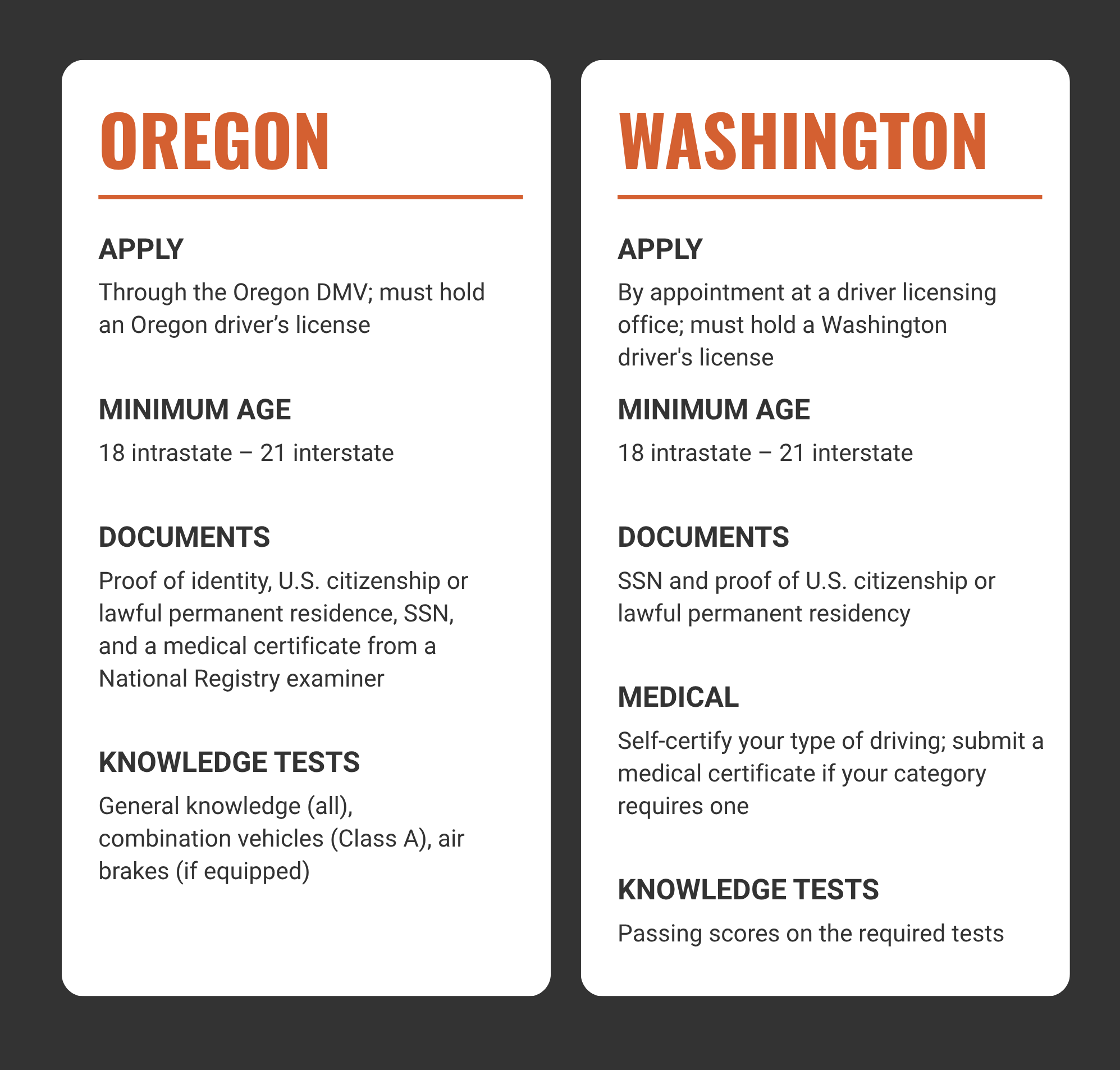
- Oregon: Applicants apply through the Oregon DMV and must already hold an Oregon driver’s license. The minimum age is 18 for intrastate driving and 21 for interstate driving. Oregon requires proof of identity and U.S. citizenship or lawful permanent residence, a Social Security number, and a medical certificate from an examiner listed on the National Registry.
Required knowledge tests include general knowledge for everyone, combination vehicles for Class A, and air brakes when the vehicle has them. Oregon offers these tests in English only, and passing scores stay valid for six months. The full list is on the Oregon CDL requirements page.
- Washington: Applicants make an appointment at a driver licensing office and must already hold a Washington driver’s license. The minimum age is 18 for intrastate driving and 21 for interstate driving. Washington requires a Social Security number and proof of U.S. citizenship or lawful permanent residency.
Applicants self-certify their type of driving and submit a medical certificate when that category requires one. They also need passing scores on the required knowledge tests. The full list is on the Washington CDL requirements page.
ELDT and Training Requirements
Federal Entry-Level Driver Training (ELDT) rules require first-time Class A and Class B applicants to complete training through a provider listed on the FMCSA Training Provider Registry. That training must be finished before the CDL skills test, not before the state issues the CLP. Both states verify the training record is on file before scheduling a skills test.
Elite Truck School’s 160-hour Class A CDL program meets ELDT requirements. Full-time students can finish in as little as four weeks. Students earn their CLP during the first week, and road training runs in small groups of about three students per instructor.
What can a CLP Holder Do?
A CLP holder can drive the permitted vehicle class on public roads for training only. The driver must also carry a valid state driver’s license. A qualified CDL holder must sit in the front seat and supervise directly. Washington adds that the supervising driver needs at least two years of experience in that vehicle type, plus five years of total driving experience. The permit holder cannot drive alone under any circumstance.
A CLP holder cannot haul hazardous materials. A permit with a passenger (P) or school bus (S) endorsement cannot carry passengers other than trainers, test examiners, other trainees, and federal or state auditors and inspectors. A permit with a tank (N) endorsement covers only an empty tank vehicle that has been purged of all hazardous residue.
A CLP supports supervised training, not a solo paid driving job. Whether a carrier pays a trainee during training depends on that employer’s program.
How Long Does a CLP Last?
An Oregon CLP is valid for one year and cannot be renewed. A Washington CLP is valid for 180 days. It can be renewed once for another 180 days if the driver renews within 30 days of the expiration date.
Federal rules limit any CLP to one year from the original issue date before the driver must retake the knowledge tests. Federal rules also require every driver to hold a CLP for at least 14 days before taking the CDL skills test. At Elite, students get their CLP in the first week of training, so the 14-day wait passes while they train on the range and road.
What Does a CLP Cost?
In both states, the permit itself costs little. Oregon charges $40 for the CLP, plus $10 for each knowledge test. Washington charges $40 for the CLP, plus a $35 testing fee that covers one attempt at each knowledge test taken within 90 days. The main cost students should plan for is the CDL training program; they can review tuition and funding options before enrolling.
Ready to Move Past the Permit?
A CLP is a first step, not a finish line. Students ready to turn their CLP into a career can explore CDL training programs at Elite Truck School. The school runs five campuses across Oregon and Washington.
Road training runs in small groups, and graduates get job placement support after finishing the program. Elite Truck School has trained drivers in the Pacific Northwest since 2003.
Call Elite Truck School at (503) 615-8465 to schedule a tour or visit the admissions page to start an application.
Frequently Asked Questions
Is a CLP the same as a CDL?
No. A CLP allows supervised practice only, while a CDL allows solo commercial driving after the driver passes the skills test.
Can I drive a semi-truck with only a CLP?
Yes, but only for training with a qualified CDL holder in the front seat. The driver must also carry a valid driver’s license, and driving alone is never allowed.
Do I need a CLP before starting CDL school?
No. Elite students get their CLP during the first week of the Class A program, and staff help them through the process before behind-the-wheel training begins.
Can the CLP knowledge test be taken in another language?
It depends on the state. Oregon offers the tests in English only, while Washington also offers them in Spanish, Russian, and Serbo-Croatian.
Can a failed drug test stop someone from getting a CLP?
Yes. A state cannot issue a CLP to a driver with a “prohibited” status in the FMCSA Drug and Alcohol Clearinghouse.
What happens if a CLP expires before the skills test?
In most cases, the driver must apply for a new permit and retake the knowledge tests. Washington allows one renewal within 30 days of the expiration date, but Oregon permits cannot be renewed.
Does a CLP transfer between states?
No. A CLP is tied to the issuing state’s driver’s license, and Oregon does not accept out-of-state permits to waive knowledge tests, so drivers who move should plan to retake the knowledge test.
