
CDL Requirements: Are You Eligible in Oregon?
Getting your Commercial Driver’s License (CDL) requires meeting federal requirements set by the Federal Motor Carrier Safety Administration (FMCSA). Here’s what you need to qualify.
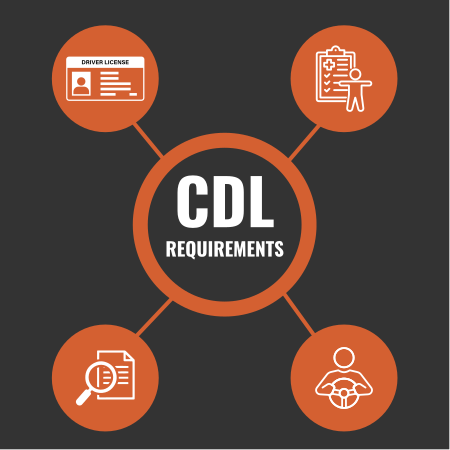
Requirements Summary
- Age Requirements (18 intrastate / 21 interstate)
- Valid Driver’s License & Experience
- Driving Record Standards
- DOT Physical & Drug Screening
- Proof of Identity & Legal Presence
- Oregon State-Specific CDL Rules
- ELDT Requirements
1. Meet Federal Age Requirements
Federal law sets minimum age requirements for CDL holders based on how and where you plan to drive.
Intrastate vs. Interstate Eligibility
- Intrastate CDL (18-20 years old):
- Allows you to operate a commercial vehicle within the state where the CDL was issued. You may not cross state lines or transport federally regulated interstate freight
- Interstate CDL (21 Years old and up):
- Required to drive across state lines or operate in interstate commerce. Most regional and over-the-road trucking jobs require interstate eligibility
While drivers can begin CDL training at 18, turning 21 significantly expands job opportunities, pay potential, and career options.
2. Have a Valid Driver’s License
You must hold a valid driver’s license for non-commercial vehicles. Most states also require at least one year of driving experience to prove you understand basic traffic laws and road safety.
3. Maintain a Clean Driving Record
The FMCSA sets federal disqualification standards for CDL holders. You cannot have:
- DUI convictions while operating any vehicle
- Leaving the scene of an accident
- Felony involving a vehicle
- Any CDL suspension or revocation in any state
- Refusing drug or alcohol testing
First-time DUI offenses result in a minimum 1-year CDL disqualification. A second DUI results in lifetime disqualification.
Individual states may have additional requirements regarding moving violations, accidents, and speeding violations.
4. Pass DOT Physical and Drug Screen
All CDL applicants must complete a DOT medical exam and federal drug screen with an FMCSA-certified examiner. These nationwide requirements confirm you’re medically qualified to operate a commercial vehicle.
The exam reviews basic health and physical ability, while the drug screen checks for federally prohibited substances. Medical certificates are typically valid for up to 24 months, depending on your health.
5. Prove Identity and Legal Presence
You must provide proof of U.S. citizenship or lawful permanent residence. Acceptable documents include:
- Birth certificate
- U.S. passport
- Permanent resident card (green card)
- Valid military ID card
- Social Security Number
Specific document requirements may vary by state, so check with your local DMV for their accepted forms of identification and proof of residency.
6. Oregon-Specific Requirements
In addition to federal requirements, Oregon has these state-specific requirements:
Driving Record Standards
- No more than 3 moving violations in the past 3 years
- No major at-fault accidents in the past 5 years
- No DUI or reckless driving in the past 3 years
- No speeding 15+ mph over the limit in the past 3 years
Additional Oregon Requirements
- At least 1 year of driving experience required
- CDL holders cannot use traffic diversions to remove violations
- Must hold Commercial Learner’s Permit (CLP) for at least 14 days before skills test
- All CDL tests are only available in English
- Proof of Oregon residency required (utility bills or bank statements)
School Bus Endorsements (Oregon)
- 15 hours of Oregon Department of Education (ODE) Behind the Wheel training
- ODE driving and criminal record check
7. Complete Entry Level Driver Training (ELDT)
Since February 2022, FMCSA requires all new CDL applicants to complete Entry Level Driver Training through an FMCSA-approved training provider. This federal mandate applies nationwide and includes both classroom instruction and behind-the-wheel training.
ELDT is required for:
- First-time Class A or B CDL applicants
- Upgrading from Class B to Class A
- Adding passenger (P), school bus (S), or hazardous materials (H) endorsements for the first time
Find FMCSA-approved training providers through the FMCSA Training Provider Registry. Training providers include community colleges, private truck driving schools, and employer-sponsored programs.
Federal Testing Requirements
All CDL applicants must pass federal standardized tests:
Knowledge Tests
- General Knowledge Test (required for all CDL applicants)
- Combination Vehicles Test (required for Class A)
- Air Brakes Test (if operating vehicles with air brakes)
Skills Test (Three Parts)
- Pre-Trip Vehicle Inspection – identify vehicle components and explain safety checks
- Basic Control Skills – backing and maneuvering exercises
- Road Test – driving in traffic with evaluation of safe driving practices
FAQs About CDL Requirements
What are the federal requirements to get a CDL?
In order to qualify to earn your CDL, you need to:
- Be at least 18 years old (21 for interstate)
- Have a valid driver’s license
- Pass a DOT physical and drug screen
- Provide proof of identity and legal presence
- Complete ELDT training through an ELDT-compliant provider
- Maintain a clean driving record
Do I need to live in the same state where I get my CDL?
Yes. CDLs are recognized nationwide under federal law. If you wish to move to a different state you will have to transfer your CDL to that state.
Are CDL requirements the same in every state?
Federal CDL requirements are the same nationwide, but states like Oregon and Washington add their own rules. Washington requires minimum training hours, while Oregon does not.See Oregon-specific requirements.
Do I have to get training to get a CDL?
Yes. Since February 2022, the FMCSA requires all new CDL applicants nationwide to complete Entry Level Driver Training through an FMCSA-registered provider. This federal mandate applies to first-time Class A or B applicants, license upgrades, and certain endorsements.
Can I get a CDL with a DUI on my record?
A first DUI conviction results in a minimum 1-year CDL disqualification. A second DUI results in lifetime disqualification from holding a CDL. These are federal FMCSA regulations that apply nationwide.
What documents prove identity and legal presence?
You need proof of U.S. citizenship or lawful permanent residence such as a birth certificate, U.S. passport, permanent resident card (green card), or valid military ID. You also need your Social Security Number. Specific requirements may vary by state.
What are the federal CDL endorsement requirements?
Hazardous Materials (H) endorsement requires a TSA background check and ELDT. Passenger (P) and School Bus (S) endorsements require ELDT training. School Bus also requires the Passenger endorsement first. All endorsements require passing additional knowledge tests.
What’s the difference between Class A, B, and C CDL?
- Class A is for vehicle combinations with a gross combination weight rating of 26,001+ pounds where the towed vehicle exceeds 10,000 pounds
- Class B is for single vehicles with GVWR of 26,001+ pounds
- Class C is for vehicles transporting 16+ passengers or hazardous materials
Each higher class also authorizes operation of lower classes.
Can I get a CDL if I have a medical condition?
That depends. Certain medical conditions that aren’t serious may not disqualify you from getting your CDL. However, there are a variety of conditions, like diabetes, seizure disorders, and heart conditions, that may cause restrictions or even disqualify you. Check with a DOT-registered medical examiner to determine your qualification.